
The most powerful applications are built around one story. We help each student find theirs.
What we actually do
Every engagement starts with an honest read on your student — their profile, their goals, and the gap between where they are and where they want to be. From there, we build a strategy calibrated to how selective colleges actually evaluate applications in 2026: which activities matter, what story the application is telling, where to apply early, and whether the schools your family has in mind are realistically in reach. If they’re not, we’ll help the student realign their expectations with their fit.
Our Principles
- Truth Over "Happy Talk": Realistic projections, not sugar-coated promises.
- Clarity Over Anxiety: No jargon, no fog, and zero manufactured urgency.
- Skills for Life: Strategic thinking and clear writing—tools that outlast the application.
- Equity in Access: Premium guidance for our clients; pro bono support for the community.
Where is your student right now?
Most families recognize themselves in one of these. Each one has a different gap — and the right next step depends on which one fits.
The Stats Baseline - "Our kid has the grades and the scores. We’re set."
With tens of thousands of valedictorians graduating every year, a 4.0 and a 1500 are just the baseline. At elite schools, high stats only guarantee that your student’s application will be read, not that they will be admitted. Everything that decides the outcome happens above that line.
Where this leaves you: The work ahead is identifying what makes your student truly distinctive—and building those traits deliberately while there is still time to influence the narrative.
The Depth Deficit - "Our kid is doing activities. Lots of them."
A long list of unrelated commitments is the extracurricular equivalent of a mediocre SAT score; it shows effort, not differentiation. Selective colleges aren’t looking for a “well-rounded” student; they want a clear identity supported by depth, output, and external recognition. everything else, not a list of unrelated commitments.
Where this leaves you: The work ahead is identifying the 1–2 things that deserve real focus and determining what kind of output—research, leadership, or creation—will actually move the needle.
The "Standard Strong" Trap - "Our kid has strong grades and strong activities. We should be fine."
To an admissions committee, this looks identical to thousands of other applications. They call it “standard strong”—technically proficient but forgettable. Without a coherent narrative to advocate for, even the most impressive resumes fail to leave a lasting impression.
Where this leaves you: The work ahead is finding the “thread”. The singular identity the application is built around and ensuring every essay, activity, and recommendation reinforces it.
The Late Start - "We are running out of time."
It’s senior fall and the runway is short. While you can’t change the past, you can change the strategy. Success for late-start students depends on narrative repositioning, strategic use of early rounds, and a college list calibrated to where the student actually fits.
Where this leaves you: This is triage, not long-term planning. The work ahead is faster, sharper, and more focused—maximizing the impact of the remaining time through expert execution.
If any of these sound familiar, let’s start that conversation.
Four things selective admissions actually rewards
Where we go deep
Five places where the work meaningfully changes outcomes — and where families typically don’t know what they don’t know.

Academic Transcript Strategy
Course selection calibrated to your student’s school context and target colleges.
- The right APs in the right sequence — not just the highest count
- Electives chosen for depth, not box-checking
- A trajectory that signals real intellectual ambition

College List & Fit Analysis
A list built around your student’s profile and the institutional priorities of each school.
- Beyond the generic reach / target / safety template
- Deliberate ED, EA, or REA calls based on the math
- Matched to schools where your student actually fits

Essays That Sound Like Your Student
Personal statements and supplements written in your student’s voice.
- Topics that admissions readers actually want to read
- Every supplement school-specific, not recycled
- Edited for clarity without losing the student's voice

Activities & Awards That Compound
Strategy for which activities to deepen, which to drop, and what kind of output and recognition actually moves the needle.
- Real beats manufactured. Admissions readers can spot the difference between a student who built something over years and one who assembled a resume.
- The activities that stand out produce something tangible: published work, a leadership role earned through commitment, recognition that came without chasing it.
- Awards should compound, not scatter. One competition track pursued over multiple years, each result building on the last, tells a clearer story than a dozen unrelated entries.
- Sometimes the smartest move is subtraction. The student spending 20 hours a week on a sport they'll never play in college is consuming the time that could go toward the thing that actually sets them apart.

Recommendations With Strategy
Choosing the right teachers and giving them what they need to write something that actually helps.
- The right recommenders for your student's narrative
- Briefed on what to emphasize, with real context
- No more generic "great kid" letters
The SmartTools behind every
Elite engagement
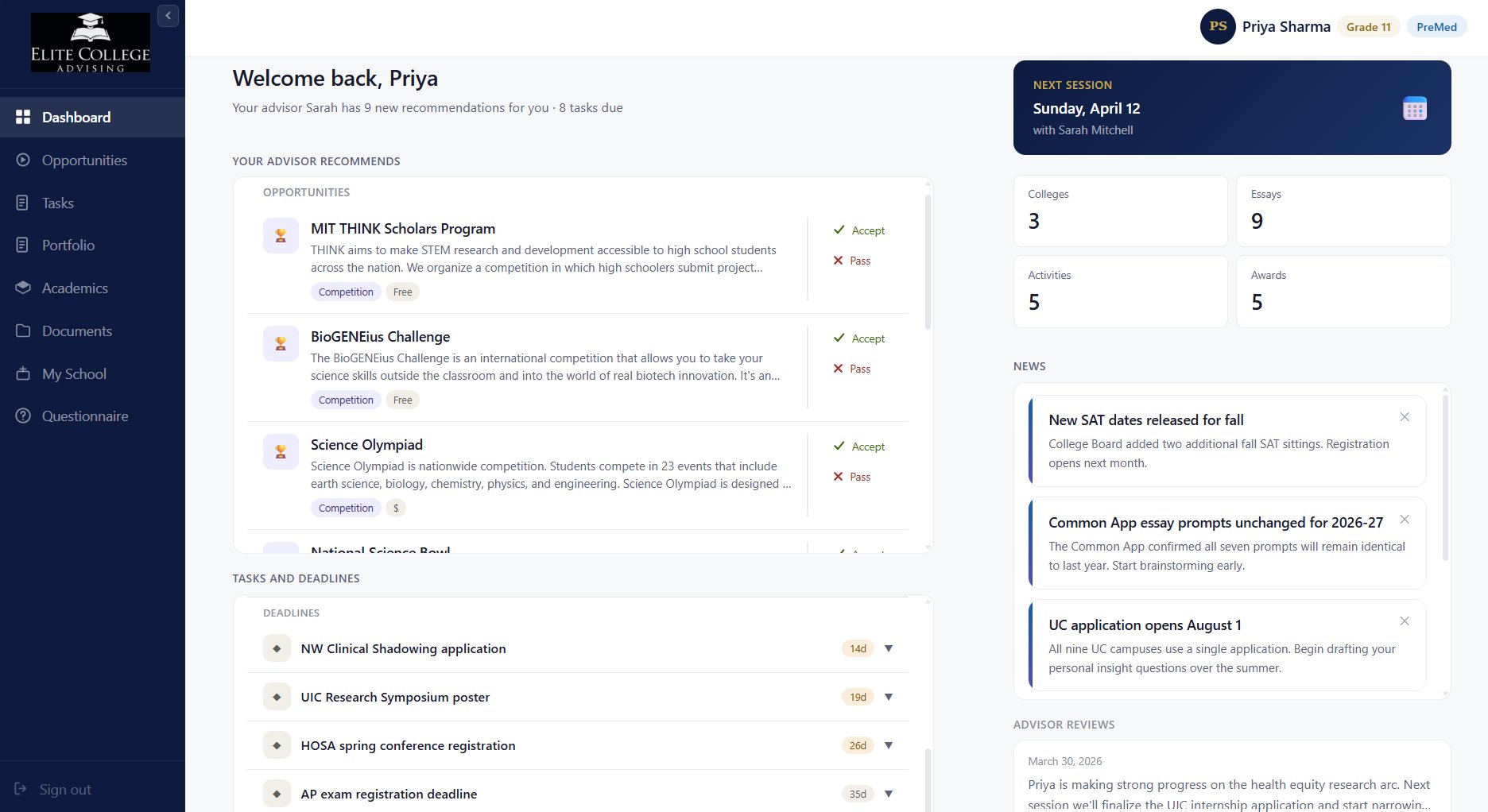
Every engagement includes SmartTools, our platform for tracking college lists, deadlines, essays, and advisor notes in one place. Behind the scenes, it builds on what we’ve learned across every student we’ve worked with, so every recommendation is informed by real outcomes, not guesswork.
- College list, deadlines, and application tasks in one place
- Opportunities surfaced based on your student's profile
- Every advisor session note organized and searchable
Grade-Level Admission Checklists
Grade-Level Admission Checklists
9th Grade
- Explore widely. Take varied classes, sample clubs, sports, and activities — find what you keep coming back to.
- Stay on track in the academic sequences that matter — math and language tracks are sequenced years out.
- Try a competition. AMC 10, debate scrimmages, Science Olympiad, a writing contest.
- PSAT diagnostic to see where you stand.
- Summer: keep exploring. Don't optimize — try things.
10th Grade
- Take stock. Which 1–2 of last year's interests stuck — and where did you actually have some talent? That's where the depth starts.
- Increase academic rigor — AP/IB/honors where the school offers them.
- Take competition seriously. If AMC 10 clicked in 9th, start preparing for AIME. The second time you enter something is when you really try.
- PSAT/National Merit prep begins.
- Summer: go deeper in one direction. Real research exposure, structured competition prep, an independent project with a clear output.
11th Grade
- Take the highest rigor available — AP/IB/dual enrollment.
- SAT/ACT — finalize testing this year.
- Pursue your spike deliberately: depth over breadth, output over participation. AIME, USAMO, published work, a poster, a paper.
- Build a targeted college list and start visiting schools to form real impressions.
- Begin personal statement brainstorming in late spring.
- Summer: produce something. The work that shows up on your application is the work that happens this summer.
12th Grade
- Finalize the narrative — one coherent story your application is telling.
- Lock the early application strategy — ED, EA, or REA chosen as a deliberate call, not a default.
- Essays finessed: personal statement and every supplement school-specific.
- Maintain grades — senior year transcript still matters.
- Recommenders briefed and supported with the context they need.
- Common App complete and ready to submit by the deadlines.
What this looks like in practice
Two students. Two very different starting points. One thing in common: the strategy was built around who they actually were — not who their stats said they should be.
Institutional Fit: Finding the Path to Vanderbilt Beyond the Stats
With stats below her reach targets, we shifted focus to his deep service and character. By matching his profile to specific institutional priorities and a niche program, we found the perfect fit.
The result? Admission to Vanderbilt.
Selective admissions is a puzzle of institutional needs, not just a contest of numbers. Most families fixate on average stats while ignoring the specific priorities—character, service, or niche programs—that actually secure the seat.
The Early Pivot: From Forgettable to Yale
Referred in senior fall, this student had a technically sound but forgettable application—and no plans for early action. We rebuilt her narrative in weeks to match her potential and identified the ideal early target.
The result? Admission to Yale.
Most selective schools fill 40–60% of their class through some form of early round — ED, REA, or EA — and most families treat the choice as a checkbox instead of a strategic call.
"Senior year was overwhelming until I finally had structure. Clear deadlines, essay guidance, strategy sessions — every step felt intentional."
"As a freshman, I didn't understand the college process at all. Amit helped me choose classes, explore interests, and build a strong foundation early. Now I feel organized, motivated, and confident."
Frequently asked questions
What does a college admissions consultant actually do?
A college admissions consultant works with a student and family across high school to develop the academic, extracurricular, and application strategy that produces the strongest possible college outcomes. At Elite College Advising, that includes course selection, activity strategy, college list development, essay coaching, recommender strategy, interview prep, and financial aid guidance. The work is most effective when started before senior year, but we also work with students on shorter timelines.
When should we hire a college admissions consultant?
The earlier the better, but the right time depends on the student’s grade. Families with 8th and 9th graders benefit from foundational academic and activity planning. Sophomore and junior families gain the most from strategic positioning and college list development. Senior families typically need focused help with essays, applications, and the early-round decision. We work with students at every stage — the work just looks different.
How is Elite College Advising different from larger admissions consultancies?
We are a boutique practice, not a high-volume operation. We maintain a 1:5 counselor-to-student ratio, which means each family receives genuine attention rather than templated advice. Every strategy is built around the specific student — their strengths, their story, and the specific schools where that story resonates. We don’t run students through a formula.
Do you guarantee admission to specific colleges?
No reputable admissions consultant guarantees admission, and we do not. What we offer is a strategy calibrated to the student’s actual profile and the specific schools where that profile is strongest. Our students are routinely admitted to their target schools because the strategy is realistic from the start — not because we have backdoor influence at any institution.
Do you only work with students applying to Ivy League schools?
No. While our students have been admitted to Harvard, Yale, Princeton, Stanford, and similar schools, the right college list is the one that fits the specific student. Many of our most successful outcomes are at schools outside the top 20 — schools where the student’s strengths matched institutional priorities and produced both admission and meaningful merit aid.
Do you work with international students?
How does the free 30-minute strategy session work?
The strategy session is exactly what it sounds like — 30 minutes, no pitch, no contract. We discuss where the student currently stands, what their goals are, and where the gaps are between the two. If we’re a good fit to work together, we’ll discuss next steps. If we’re not, we’ll point you in a useful direction. Either way, you’ll leave with an honest read on the student’s situation.
Ready for a conversation about your student?
Thirty minutes. No pitch. No contract.